From the Stacks: John Bardes
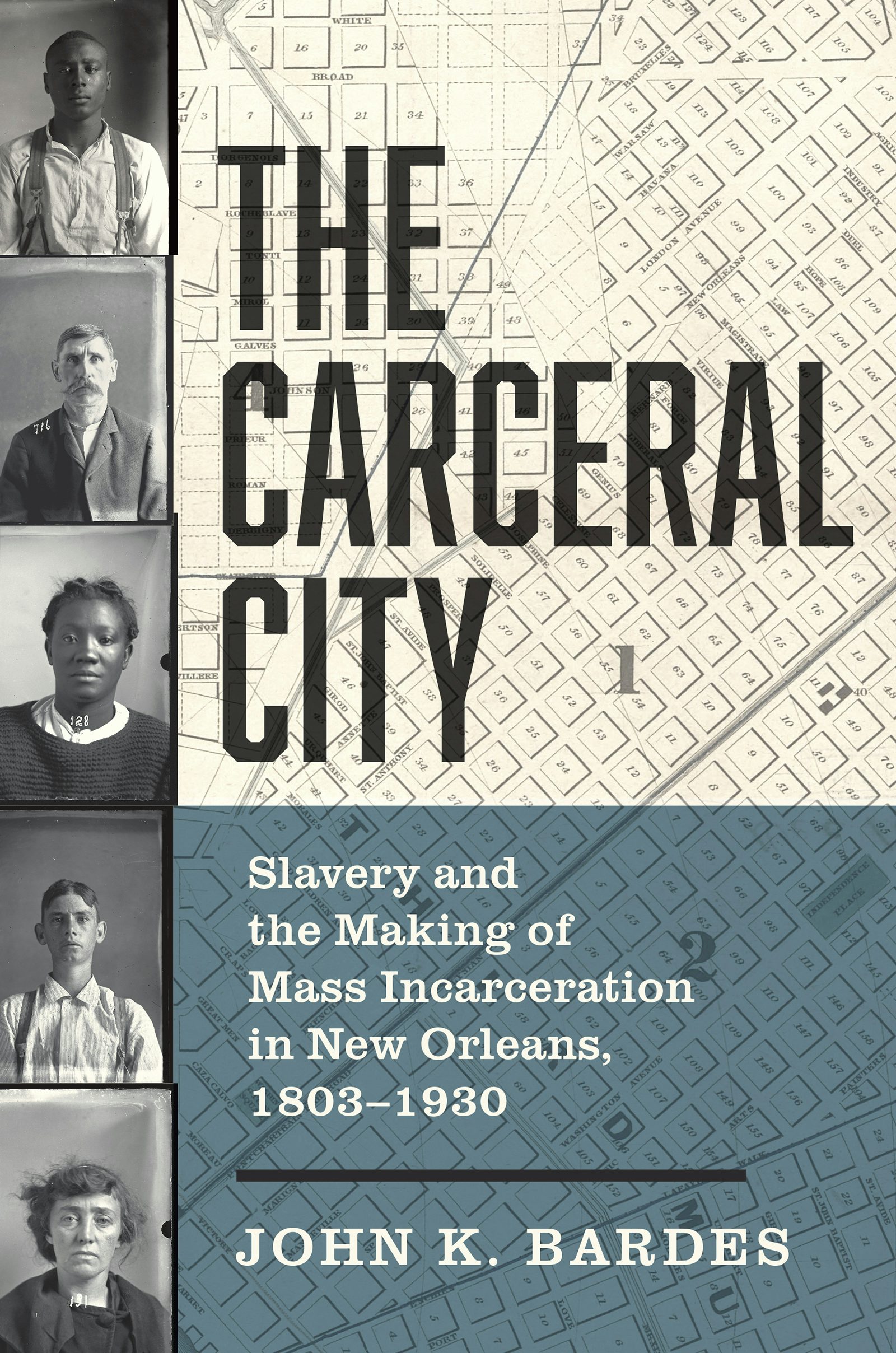
LSU Libraries celebrates the research and creativity of LSU faculty through "From the Stacks: LSU Faculty Authors," a monthly Q&A series highlighting recent books written by LSU faculty members. This initiative highlights recent publications, offering insight into the scholarship that shapes the university’s academic community. All faculty-authored books are included in the Libraries’ physical collection and as part of the faculty book list in the LSU Scholarly Repository.
John Bardes
John Bardes is an assistant professor of history whose work examines slavery, policing, and carceral institutions. His book, The Carceral City: Slavery and the Making of Mass Incarceration in New Orleans, 1803—1930 (UNC Press, 2024), argues that slavery fundamentally shaped the development of prisons and racialized policing. With evocative prose, Bardes shows mass incarceration as a long-standing outcome of these intertwined systems.
Tell us about your field of study and what attracted you to it.
I'm a historian of slavery and emancipation in nineteenth-century United States. As a kid, I was obsessed with Greek myths, and how the stories people tell about themselves and pass on to others shape and structure their present. As a teenager, I became fascinated by African American history and the fundamental questions it raises about inequality, justice, violence, freedom, human rights, coercion, community, creativity and survival. After college, my first job was teaching in a high school; I grew deeply perturbed by the ways racialized constructions of criminality shaped my students’ lives and experiences. In short, the themes that define my intellectual life have developed alongside my life.
Does writing come easily to you, or is it a struggle?
The struggle is the point! Writing is like exercise: always a painful joy.
What drew you to the specific subject of your book, mass incarceration? What do you want readers to take away from your book?
Particularly over the last twenty years, the idea that mass incarceration evolved as a “replacement” for slavery has grown tremendously popular among activists and scholars. Simply put, I wanted to show that the relationship between slavery and state coercion is both older and more complicated than most people realize. My next book explores covert communication networks under slavery.
What is your writing routine and how long did it take to research/write your book?
I devoted nine solid months to uninterrupted archival research but also did a lot of follow-up research. Writing the book took three years; editing took another one to two years. Personally, I like to start my day with writing – I get my best ideas down between 8 a.m. and 11 a.m. By noon, my writing deteriorates, so I often devote afternoons to research, reading, and coursework.
What works do you consider essential for anyone in your field?
Typing sentences into a word processor is a solitary act, but to write is to engage in an ongoing, ephemeral conversation with thousands of scholars, past, present and future. It’s a little bit like asking what screw or bolt is most important to an airplane…they’re almost all vital to the flying of the overall machine.
What advice do you have for students, researchers, and writers in your field?
Read and write all the time. It’s through the acts of reading and writing that we sharpen our thinking and skills.
Anything else you’d like to add about yourself?
I grow lots of okra in my backyard. Right now, it’s okra season; my plants are eight feet tall and give me a full bucket of okra every two days. I can’t eat the stuff fast enough…
LSU Libraries supports faculty authors by collecting and preserving their work in the LSU Scholarly Repository and by helping make LSU research more widely discoverable through open-access initiatives.